What to Anticipate » BedTimes Journal
Estimated studying time: 9 minutes
Editor’s Word: The next article offers evaluation and a forecast for the U.S. financial system typically. It’s not meant to present a forecast particularly for the mattress business. Additionally, the predictions on this article don’t essentially mirror the views of the Worldwide Sleep Merchandise Affiliation.

Producers can sit up for a regularly enhancing, if difficult, working atmosphere in 2026. “The U.S. financial system is holding up admirably effectively regardless of a serious commerce shock attributable to tariffs,” mentioned Bernard Yaros Jr., lead U.S. economist at Oxford Economics. “We search for an acceleration in development in 2026 as stimulus from the One Huge Stunning Invoice will get underway.”
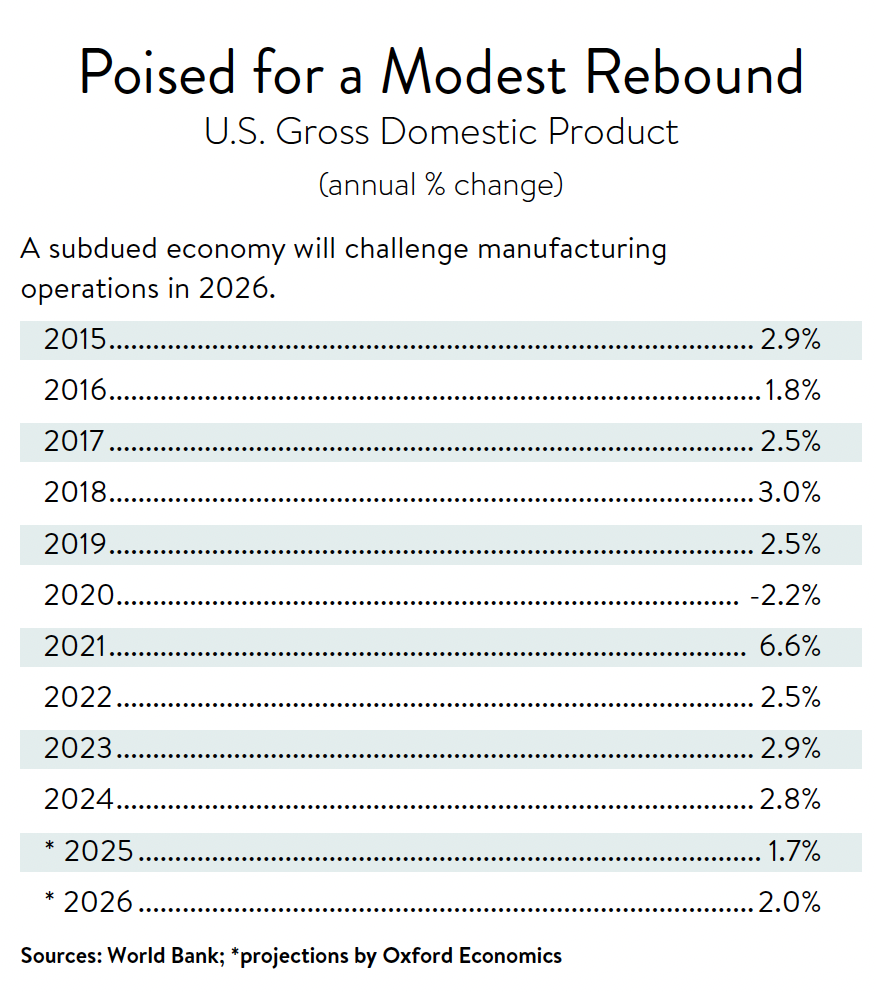
Oxford Economics, based mostly in Oxford, England, with U.S. headquarters in New York, expects actual gross home product to develop by 2% in 2026, up a bit from the 1.7% anticipated when 2025 numbers are lastly tallied. Each years — among the many most sluggish development environments of the previous decade — are expect-ed to underperform the two.8% GDP improve of 2024. (GDP, the entire worth of the nation’s items and companies, is essentially the most generally utilized measure of financial development. Actual GDP subtracts the consequences of inflation.)
Aiding Progress: Stimulus, Commerce Readability, and Bettering Credit score Circumstances
The nation’s financial development relies upon largely on the launch of recent enterprise initiatives. Sadly, producers are holding again for a variety of causes. Rates of interest, whereas declining, are nonetheless on the highest ranges since 2022. Prices for ma-terials and provides are growing. There’s uncertainty in regards to the nation’s future commerce coverage. Decrease- and middle-income shoppers, nervous about inflation, are tapped out and shutting their wallets. Towards such headwinds, a number of in any other case at-tractive initiatives can look much less promising.
One may also count on enterprise profitability to undergo. But Ox-ford Economics expects it to observe the identical basic sample because the GDP. “We search for company earnings to rise by 4.9% in 2026,” Yaros mentioned. “That’s up considerably from the 0.5% anticipated when 2025 numbers are finalized.” Even so, the 2026 tempo stays slower than the 7.9% revenue development clocked in 2024.
The anticipated 2026 rebound in profitability stems from a be-lief that stimulus from Washington, D.C., will raise all boats. “We imagine the passage of the One Huge Stunning Invoice, with its tax cuts for companies and households, ought to assist the financial system regather some steam in early 2026,” mentioned Anirban Basu, chair and CEO of Sage Coverage Group, an financial and coverage consul-tancy based mostly in Baltimore. The laws’s 100% bonus depre-ciation ought to assist gas enterprise funding, whereas massive tax refunds ought to invigorate shopper spending. Each actions are vital drivers of the nation’s financial system.
This federal stimulus is arriving on the identical time manufac-turers are getting a extra stable footing on the nation’s shifting commerce coverage. “There was a little bit of a shock to the system in and round tariffs over the previous yr, and it’s taking a while for a lot of corporations to know their influence,” famous Andrew Petryk, head of industrials at Brown, Gibbons Lang & Co., an funding financial institution headquartered in Cleveland.
Particularly, corporations have responded to China tariffs by sourcing imports from different nations — a transfer that has additionally helped the nation’s latest provide chain ills. “Lead occasions have diminished as corporations have discovered different or extra suppliers,” Petryk mentioned. “People who relied on one or two distributors now have three, 4 or 5.”
Producers also needs to profit from a decline in the price of cash over the approaching months, because the Federal Reserve shifts its focus from combating inflation to bolstering employment. “We search for inflation to peak at simply above 3% when 2025 numbers are finalized, and for the Fed to chop rates of interest into 2026 till the federal funds fee falls to about 3%,” Yaros mentioned. That fee, whereas a lot greater than the charges of early 2022, is a substantial enchancment over the 4.3% of mid-2025.
Declining rates of interest, which encourage companies to launch new initiatives, are additionally a mirrored image of looser pockets on the a part of the nation’s lenders. “Credit score situations have improved considerably for companies,” Basu mentioned. “Firms with robust stability sheets will discover bankers very prepared to provide debt. We additionally know that fairness traders, together with non-public fairness, stay fairly aggressive in supplying capital.”
Analyzing Continued Headwinds within the Housing Sector
Talking of decrease rates of interest, they’ll’t come quickly sufficient for a serious driver of the nation’s financial exercise: the housing sector. “Housing is in a funk,” Yaros mentioned. “Single-family homebuilders are contending with a rising provide of unsold, accomplished new houses, in addition to larger competitors from the resale market and falling house costs in a rising variety of areas.”
The excessive price of cash shouldn’t be serving to issues. “A big improve in rates of interest for the reason that summer season of 2022 has elevated the month-to-month funds required from consumers of recent or present houses,” Petryk mentioned. “They’ve additionally led to a big market scarcity as a result of households who purchased houses three- to five-plus years in the past are loath to give up their sub-3% mortgages.”
Mortgage charges have an vital influence on the buyer attitudes which can be very important drivers of the financial system. Whereas decrease short-term charges could also be coming from the Federal Reserve,
it’s unclear how a lot impact they are going to have on the longer-term ones that apply to the funding of recent houses. “I don’t forecast mortgage charges coming down sufficient to make an enormous distinction in single-family development,” mentioned Invoice Conerly, principal of his
personal consulting agency in Lake Oswego, Oregon.
Cautious builders. Reluctant sellers. Sluggish consumers. It’s all having an impact on the housing market. Oxford Economics expects housing begins to fall by 4.3% in 2025 and decline by one other 2.3% in 2026 after dropping by 3.5% in 2024. Costs for present houses are anticipated to extend only one.5% in 2025 and a pair of.3% in 2026 after rising by 4.4% in 2024.
Involved in regards to the rising price of residing, shoppers are slicing again on spending of all types. Their hesitancy impacts the retail sector, which is a crucial driver and bellwether of the financial system. “Our forecast for year-over-year retail gross sales development is 3.8% for 2026, down from the 4.5% of 2025,” mentioned Scott Hoyt, senior director of shopper economics for New York-based Moody’s Analytics. A lot of these will increase in each years is because of inflation. “Excessive costs are a little bit of a blended bag,” Hoyt mentioned. “They undermine shopper buying energy and confidence, however additionally they help nominal gross sales by lifting the costs of the products retailers are promoting.”
Various Outlook for Nonresidential Development: Knowledge Facilities vs. Different Sectors
Exterior of the single-family house market, contractors are having issues of their very own. Multifamily builders, working via a backlog of models underneath development, are hesitant to interrupt floor on new ones. “I feel we’ll see much less multifamily development in 2026,” Conerly mentioned. “Emptiness charges are going up and rents have been coming down on the fee of about 1% a yr.”
In the meantime, contractors hooked up to the business, workplace and resort markets are feeling the sting of a slowing financial system, excessive rates of interest and an atmosphere rife with uncertainty. “Many areas of nonresidential are trending at or edging down,” Conerly mentioned. “Even the chip fabs (factories that manufacture semiconductor chips), whereas nonetheless robust, are tapering down.”
The one brilliant development sector: knowledge facilities. They present no indicators of diminishing and are massive prospects for electricians, plumbers and suppliers of scaffolding and manufactured merchandise of all types. “Once I have a look at the element and the financial statistics of what sort of capital tools is being purchased, I’m seeing quite a lot of knowledge center-related tools in there,” Conerly mentioned. “Knowledge facilities additionally require quite a lot of backyard selection wiring, connectors and plumbing for cooling.”
Each sector of the development business shares a typical problem: labor availability. Oxford Economics forecasts an unemployment fee of 4.4% and 4.3% on the finish of 2025 and 2026, respectively. That’s not a lot greater than the 4.1% clocked on the finish of 2024. Low unemployment, largely attributable to slowing development within the nation’s working age inhabitants and aggressive immigration insurance policies, may end up in rising labor prices.
Navigating Excessive Prices and Preserving Money Movement in 2026
For all enterprise sectors, cash and labor usually are not the one manufacturing components on the rise. “The true downside is the world has change into far more costly in the previous couple of years,” Basu mentioned. “Development supplies are costlier. And naturally there are tariffs
on gadgets like metal, aluminum and copper.”
Little marvel the excessive price of doing enterprise is high of thoughts for a lot of operators. “As we head into 2026, the world of most concern for producers is revenue margin,” Basu mentioned. “Many operators are concurrently experiencing a rise in prices of delivering
companies whereas demand fades.”
Given the number of enterprise issues, it’s little marvel that many initiatives are being placed on maintain. “It’s laborious to interact in price financial savings when each supplies and labor have gotten costlier,” Basu mentioned. “Many producers are responding by not increasing their operations and attempting to trim expenditures on the margins. They’re focusing extra on money circulation preservation by slowing hiring and being much less aggressive in leasing and buying
tools, significantly tools impacted by tariff pricing.” This generalized enterprise hesitation is evidenced within the numbers. “We search for enterprise funding to extend by only one.6% in 2026, after rising by 3% in 2025 and three.6% in 2024,” Yaros mentioned.
Conclusion: Remaining Forecast and Indicators for the 12 months Forward
As we enter the early months of 2026, economists counsel that producers watch these key financial indicators for an thought of how the yr will prove:
Employment
“I’d pay shut consideration to the unemployment fee,” Yaros mentioned. An sudden decline in employment would spur quicker rate of interest cuts because the Fed seeks to bolster financial enlargement.
Shopper spending
“How is the buyer faring?” Basu mentioned. “Keep in mind that many low- and middle-income persons are exhausted nancially. Indebtedness and delinquencies are up for bank cards, mortgages and loans.”
Inflation
“If we get stubbornly excessive in ation, that can forestall additional progress on rate of interest,” Basu mentioned.
Oxford Economics nonetheless expects the nation to keep away from a recession, and the anticipated 2% GDP development is true across the degree economists peg because the nation’s “pure development fee” — one which helps enterprise
Maybe of even larger significance, although, is a bit of heralded risk to productiveness. “One factor that type of permeates the entire financial image proper now could be the nation’s low inhabitants development fee,” Conerly mentioned. “Immigration is down, attributable to Trump administration
coverage. The subsequent era coming into their working years is about the identical measurement because the retiring boomers, so there might be no web development within the labor pressure.”
Responding to this pattern, producers will search for methods to maximise their return on labor by growing output per employee, he famous. “The main target of companies in 2026 might be growing productiveness — not by whipping individuals tougher, however by offering them with higher instruments, higher coaching and higher managers.”